通信人家园
标题: Qualcomm IPQ4019 and IPQ4029 are closely related networking processors that shar [查看完整版帖子] [打印本页]
时间: 2026-6-11 10:06
作者: wifi6
标题: Qualcomm IPQ4019 and IPQ4029 are closely related networking processors that shar
Both platforms support:
- DDR3L memory
- Up to 1 GB RAM
- SPI NOR Flash
- NAND Flash
- eMMC
- SD Card interfaces
This flexibility enables manufacturers to design products ranging from low-cost home routers to feature-rich enterprise gateways.
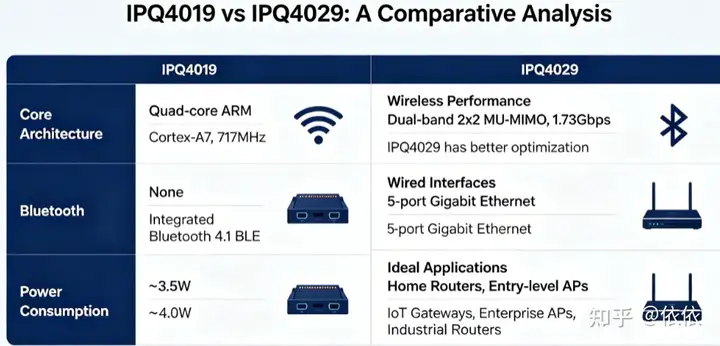
1.3 Power EfficiencyThe two SoCs share the same fabrication process and exhibit similar power characteristics:
- Low-power 28nm architecture
- Industrial-grade operating temperature support
- Suitable for indoor and outdoor deployments
Actual power consumption depends primarily on radio configuration, Ethernet usage, USB peripherals, and system design rather than the SoC itself.
2. Wireless Capabilities2.1 Integrated Wi-Fi ArchitectureBoth chips integrate dual-band Wi-Fi radios supporting:
| Feature | IPQ4019 | IPQ4029 |
| Wi-Fi Standard | 802.11ac Wave 2 | 802.11ac Wave 2 |
| 2.4 GHz Radio | 2×2 MIMO | 2×2 MIMO |
| 5 GHz Radio | 2×2 MIMO | 2×2 MIMO |
| MU-MIMO | Yes | Yes |
| Beamforming | Yes | Yes |
| Maximum PHY Rate | Up to 1.2 Gbps Combined | Up to 1.2 Gbps Combined |
Typical maximum PHY rates:
- 2.4 GHz: Up to 400 Mbps (256-QAM support)
- 5 GHz: Up to 867 Mbps
- Combined PHY Rate: Approximately 1.2 Gbps
In practical deployments, wireless performance depends heavily on antenna design, RF front-end components, software optimization, and environmental conditions.
2.2 RF PerformanceThe integrated RF architecture is largely identical between the two models:
- Dual-band concurrent operation
- 80 MHz channel support on 5 GHz
- Beamforming support
- MU-MIMO capability
- DFS channel support
From a pure Wi-Fi perspective, users should not expect major performance differences between IPQ4019 and IPQ4029.
3. The Key Difference: Bluetooth IntegrationThe most significant distinction between the two platforms is Bluetooth support.
IPQ4019- Integrated Wi-Fi only
- No built-in Bluetooth functionality
- Requires an external Bluetooth chipset if Bluetooth connectivity is needed
IPQ4029- Integrated Wi-Fi + Bluetooth
- Supports Bluetooth Low Energy (BLE)
- Enables direct communication with:
- Smart home devices
- Sensors
- IoT controllers
- Bluetooth provisioning applications
For IoT gateways and smart-home hubs, this integration reduces BOM cost and simplifies hardware design.
4. Networking and Peripheral InterfacesBoth platforms offer a rich set of networking and expansion interfaces.
EthernetIntegrated:
- 5-port Gigabit Ethernet switch
- Hardware NAT acceleration
- Wire-speed packet forwarding
- VLAN support
- QoS support
Typical deployment:
Peripheral InterfacesAvailable on both SoCs:
- PCIe 2.0
- USB 3.0
- USB 2.0
- UART
- I2C
- GPIO
- SD/eMMC interfaces
These interfaces allow integration with:
- LTE/5G modems
- External storage
- Sensors
- Industrial control modules
Security FeaturesBoth platforms support:
- Secure Boot
- Hardware crypto acceleration
- AES encryption
- DES encryption
- SHA hashing
- Hardware random number generation
These features help secure enterprise and carrier-grade deployments.
5. Software EcosystemOne reason for the long-term popularity of the IPQ40xx family is its mature software support.
Both IPQ4019 and IPQ4029 are supported by:
- Qualcomm SDK
- OpenWrt
- Linux-based networking platforms
- Mesh networking frameworks
- Enterprise WLAN solutions
The IPQ4019 enjoys broader deployment volume and therefore benefits from extensive community support, while the IPQ4029 is frequently found in IoT-focused and enterprise-grade products.
6. Typical ApplicationsRecommended Use Cases for IPQ4019- Home Wi-Fi routers
- SMB access points
- Entry-level Mesh systems
- Cost-sensitive networking equipment
- Standard enterprise AP deployments
Advantages✔ Mature ecosystem
✔ Lower BOM cost
✔ Proven long-term reliability
✔ Extensive OpenWrt support
Recommended Use Cases for IPQ4029- IoT gateways
- Smart-home controllers
- Industrial wireless gateways
- Bluetooth-enabled networking products
- Enterprise APs requiring BLE functionality
Advantages✔ Integrated Bluetooth/BLE
✔ Reduced hardware complexity
✔ Better suited for IoT deployments
✔ Lower overall system cost for BLE-enabled products
7. IPQ4019 vs IPQ4029: Quick Comparison| Specification | IPQ4019 | IPQ4029 |
| CPU | Quad-core Cortex-A7 @ 717 MHz | Quad-core Cortex-A7 @ 717 MHz |
| Process Technology | 28nm | 28nm |
| Wi-Fi Standard | 802.11ac Wave 2 | 802.11ac Wave 2 |
| Wi-Fi Configuration | Dual-band 2×2 | Dual-band 2×2 |
| MU-MIMO | Yes | Yes |
| Gigabit Ethernet Switch | 5-Port | 5-Port |
| USB 3.0 | Yes | Yes |
| PCIe | Yes | Yes |
| Hardware Crypto | Yes | Yes |
| Bluetooth/BLE | No | Yes |
| OpenWrt Support | Excellent | Excellent |
| Primary Target Market | Routers & APs | IoT Gateways & APs |
ConclusionThe Qualcomm IPQ4019 and IPQ4029 are closely related networking processors that share the same CPU architecture, wireless capabilities, and networking interfaces. For traditional Wi-Fi routers, Mesh systems, and enterprise access points, the two platforms deliver nearly identical networking performance.
The primary differentiator is the integrated Bluetooth Low Energy capability found in the IPQ4029. This feature makes it particularly attractive for IoT gateways, smart-home hubs, and enterprise deployments that require device discovery, provisioning, or sensor connectivity.
In short:
- Choose IPQ4019 for cost-sensitive Wi-Fi routers and standard access points.
- Choose IPQ4029 when Bluetooth/BLE integration is required or when developing IoT-focused networking products.
Despite the industry transition toward Wi-Fi 6 and Wi-Fi 7, both platforms continue to offer a reliable and cost-effective solution for legacy networking products, industrial applications, and embedded wireless systems.
时间: 2026-6-12 07:59
作者: 777888999
感谢分享
| 通信人家园 (https://www.txrjy.com/) |
Powered by C114 |